Advising Statement
What I can provide, what I hope you will grow into, and how we will work together.
What I Can Provide
Industrial Path
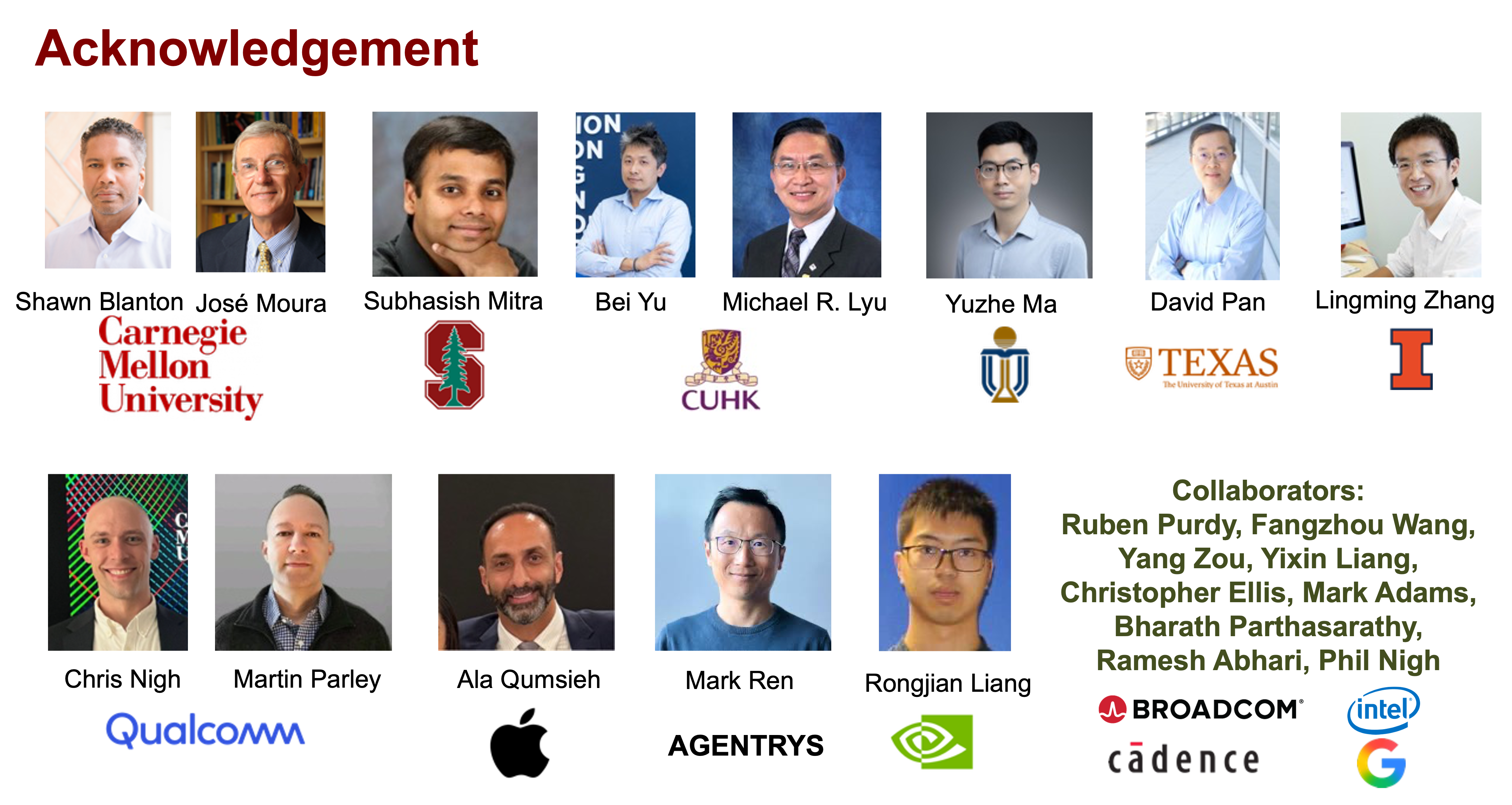
I have close relationships with industrial EDA and testing teams, especially in the U.S. semiconductor ecosystem. I received Apple Ph.D. Fellowship support twice and the Qualcomm Innovation Fellowship, and I interned in core design automation research teams at Apple and NVIDIA. I also maintain active connections around testing and reliability with teams connected to Intel, Google, Broadcom, and others.
I also know founders and early members of new AI-for-chip-design startups, including Ricursive Intelligence and Agentry. I have referred and recommended several mentees and friends into related companies, and I will be very serious about helping my students find good internships, collaborators, and industrial impact when that is the path they want.
Academic Path
I also come from a strong EDA and testing academic lineage. My CMU advisors are Prof. Jose Moura, former IEEE President and a widely respected scholar, and Prof. Shawn Blanton, a leading researcher in hardware testing. My CUHK M.Phil. advisor Prof. Bei Yu is one of the most visible EDA researchers, with deep industrial impact. My thesis committee member, collaborator, and referee Prof. Subhasish Mitra at Stanford is a leading figure in resilient computing and future chip systems.
I have also learned from and collaborated with Prof. Michael R. Lyu, Prof. Lingming Zhang, Prof. David Pan, and many others. If you hope to continue in academia, I will do my best to help you build taste, publish strong work, meet the right people, and grow into an independent researcher.
This network is not limited to traditional EDA. I also have resources for students who want to do serious AI research, not only AI as a buzzword taped onto chips. For example, Zhengyang Geng, a good personal friend and a Ph.D. student at Carnegie Mellon University advised by Prof. Zico Kolter and working closely with Prof. Kaiming He, is one of the strongest young scholars I know on one-step generation. I see great opportunities to bring one-step generation into the chip world, and I am very happy to serve as a bridge between students in my group and these AI researchers.
My Advising Style
Why Your Advisor Matters
As your Ph.D. advisor, I will wear two hats: as a supervisor, I evaluate your progress toward the degree; as a mentor, I help you grow into the researcher and person you want to become. I will also promote you and your work, both during your Ph.D. and after you graduate. Once you graduate, I hope our relationship will evolve into one between colleagues (recommendation letters aside).
An advisor can have a lasting impact on your academic life, so you should choose one carefully. People sometimes compare choosing an advisor to choosing a spouse. The analogy is imperfect, but the underlying point is right: expertise matters, and so does whether you feel comfortable working with the person. Personality and communication fit are often underestimated. This section is here to help you decide whether my style is a good fit for you; you should also talk with current group members whenever possible.
By graduation, I hope my Ph.D. students will have grown into researchers who:
- Have a signature contribution. You should have one project, or a coherent body of work, that you understand deeply and that people associate with you.
- Can explain ideas clearly. You should be able to present your work to both a general audience and experts in your field.
- Are part of a research community. You do not need to be a celebrity, but researchers in your area should recognize your expertise and be happy to work with you. I will introduce you to people, but maintaining those relationships will be your responsibility.
- Can recover from setbacks. Rejection, revision, and resubmission are normal parts of research. I hope you will develop a sustainable way to regulate your emotions, make decisions, and form a philosophy of research and life that is genuinely your own. That, to me, is part of becoming a Doctor of Philosophy.
These are goals for graduation, not expectations at admission. I would be very happy to see you develop these abilities during your Ph.D.
How We Will Work Together: Common Questions
How should we communicate?
Directly, efficiently, and with basic courtesy (a quick “Hi” is always nice). If an issue is difficult or emotionally charged, I strongly encourage you to state your view explicitly. For example, if you are tired of a project, hints such as sighing, body language, or “maybe we should have more variety” may take me a long time to understand. Saying “I want to work on something else” gives us a much better chance to discuss the real problem and find a solution. You can disagree with me; I just need to know what you actually think.
What are regular meetings for?
We will normally meet once a week. Treat these meetings as opportunities to ask for advice, not as an obligation to prove that you have made progress. Skipping a meeting because you are stuck is usually counterproductive: the moment when you have made no progress may be exactly when my help is most useful. Bring unfinished ideas, confusing results, failed experiments, and questions. Polished slides are not required.
How do you think about projects?
When teaching duties are light, I will generally suggest keeping two projects active. If one project is blocked, you can still make progress on the other. This also helps keep one setback from overwhelming your morale. Early in the Ph.D., I may suggest concrete, manageable projects so that you can learn the research process and, ideally, receive some early positive feedback through publication. Later, you should increasingly decide what you want your Ph.D. to be known for. That choice will shape your dissertation, your research identity, and often your career direction, so I expect you to take ownership of it and go deep.
Do you encourage internships?
Yes, strongly. In AI and chip research, I believe that experience in industry is far more valuable than spending every summer in the lab. I will encourage you to pursue internships and actively help you compete for good opportunities, including recommending you through my professional connections when appropriate.
An internship can provide useful income during your Ph.D. and make research possible with data, computing resources, tools, or infrastructure that only industry can offer. Just as importantly, it can help you understand how industry currently solves problems, which needs are genuinely urgent, and how industrial teams work. It also gives you the chance to build professional relationships that belong to you, independent of your advisor's network. If you learn to notice and make good use of these opportunities, you will naturally be developing into the kind of excellent researcher I hope my students will become.
Do I need to worry about funding?
For students supported by the NUS Research Scholarship, the standard first four years of funding are provided through the university. If a fifth year becomes necessary, I will take responsibility for working to secure appropriate support. Finding funding is my responsibility, not yours.
What are your expectations for graduation?
Beyond the formal School requirements, such as completing teaching duties and passing the qualifying examination, I do not want to define graduation by a rigid publication count. A hard numerical target can push students toward optimizing for quantity rather than quality, which I believe is harmful to long-term career development. The more important test is this: when you enter the job market, whether in industry or academia, people should recognize your signature work and know that you have done something excellent in a particular area.
I also understand that students often want a quantitative reference point for judging their progress. If we absolutely must translate my expectations into a number, three substantial first-author papers would normally represent a solid body of work for an NUS Computing Ph.D. Again, quality matters much more than quantity. One pioneering or genuinely influential paper may already demonstrate more than several conventional publications, and I would consider that accordingly rather than counting papers mechanically.
How long should the Ph.D. take?
In NUS Computing, a Ph.D. commonly takes four to five years. If you meet the graduation expectations above earlier, I will be happy to support an earlier graduation. However, except in truly exceptional cases, I would not encourage graduating in fewer than four years solely because a publication count has been reached. I do not want a short timeline to reward research that is merely easier to publish at the expense of work that could have real impact on industry, the research community, or society.
I am still early in my career and have limited formal advising experience. This description is partly a commitment to the kind of mentor I will work to become. Many ideas here were inspired by Favonia's advising statement, with which I strongly agree.
← Back to Join Us Interested? Email weili3@nus.edu.sg (see How to Apply).